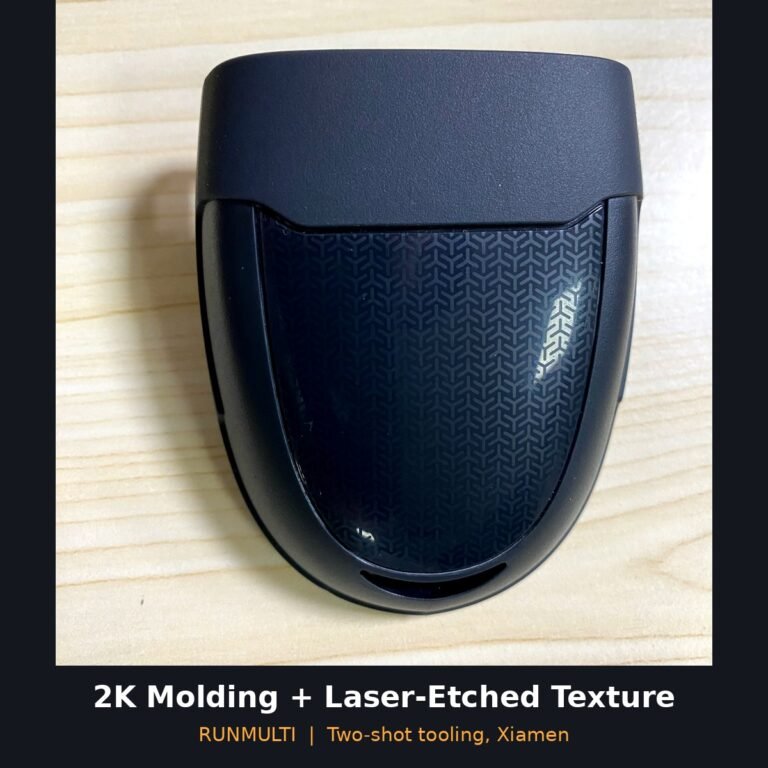
Two-Shot Molding vs Overmolding: Which Should You Choose?
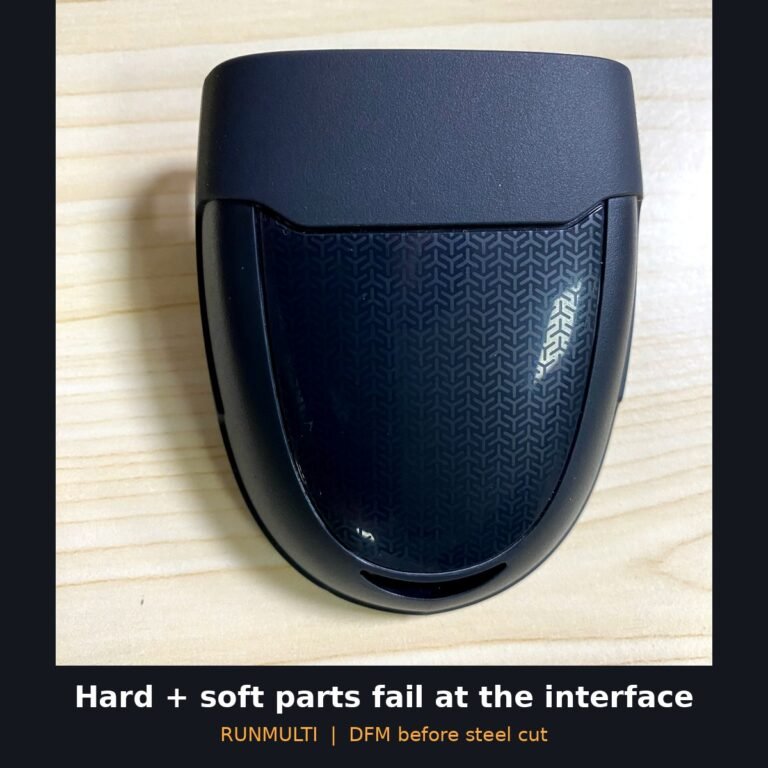
If your part needs a soft grip on a rigid housing, a sealed button edge, or two colors without assembly, you face a practical choice: two-shot (2K) molding or overmolding (pick-and-place / insert overmold)?
Both put a second resin onto a first. They differ in equipment, tooling cost, bond quality, and the volume where one becomes cheaper. This guide is for EU and US product and manufacturing engineers who need a clear trade-off before steel is cut.
At RUNMULTI, a Xiamen mold maker focused on 2K and overmolding, we frame every multi-material RFQ this way — before mold design in Creo or Siemens NX.
Quick definitions
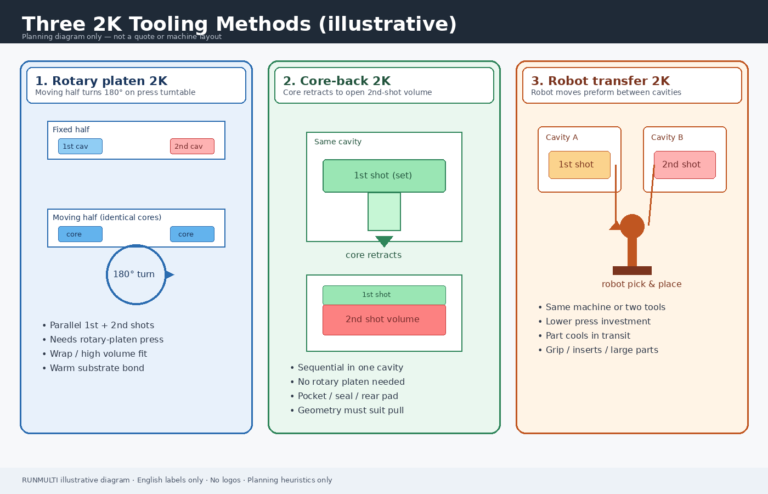
Two-shot (2K) molding injects two materials (or two colors) in one machine cycle on a dual-injection press. After the first shot, the mold indexes — rotary platen, core-back, or robot transfer — and the second shot lands on a still-warm substrate. The part leaves the press bonded, with no separate loading step between shots.
Overmolding, as most buyers mean it, molds the substrate first, lets it cool, then loads that part into a second mold for the overmold shot. Loading may be manual or robotic. The same family covers soft TPE over plastic and plastic over metal inserts.
Industry writing often treats two-shot as a subset of overmolding. For tooling quotes, keep them separate: one cycle versus two tools and a transfer.
When each wins: cost, volume, and bonding
Cost. Two-shot tooling costs more — dual cavities or index motion, tighter shut-offs, dual-barrel presses. Overmolding uses two simpler tools and often standard presses, but adds handling and cycle time. Two-shot front-loads money into steel; overmolding spends more per part. Neither is universally cheaper.
Volume. Across mold-industry guides, overmolding tends to win for prototypes and low-to-mid runs; 2K tends to win once volume is high and the design is frozen. Many sources cite roughly ten thousand parts as a planning breakpoint — useful for budgeting, not a hard law. Likely redesigns favor cheaper overmold tools; multi-year hard/soft runs usually justify amortizing a rotary or core-back tool.
Bonding. Warm-on-warm 2K favors chemical adhesion when the resin pair is compatible: the second melt can wet a hot first surface. Overmolding onto a cool substrate weakens that path. You still get good parts — but lean harder on compatible grades, clean handling (oils and fingerprints kill adhesion), and mechanical locks: through-holes, dovetails, wrap-arounds, and substrate lips that bury the soft edge so peel cannot start.
If bonding is safety-critical, test both processes with the same material pair and a peel/pull plan. Do not assume a 2K chemical bond will behave the same on a cold insert.
Choose 2K when: volume is sustained, cosmetics and shut-off alignment matter, you need maximum chemical bond, and you can invest in multi-shot tooling.
Choose overmolding when: volume is modest, the substrate may come from another supplier, materials need mechanical interlocks or broader pairing, or you need parts while a production 2K tool is still being built.
Common failure modes
Most multi-material scrap is designed in. Three patterns dominate.
Shut-off problems
The soft shot must stop cleanly against hard plastic or steel. Weak shut-offs leave a thin film of elastomer on a sealing face, button path, or mating edge. In 2K tools, shut-off geometry must also survive index motion — misaligned cavities show up as local flash or uneven soft-edge thickness.
Design cue: define the shut-off line early on a continuous, supported surface; avoid shut-offs on thin walls that deflect under clamp.
Material pair mismatch
Not every TPE sticks to every substrate. ABS/PC with many overmold TPEs can form usable chemical bonds; PP often needs grades formulated for polyolefins; acetal (POM) and polyethylene usually demand mechanical lock. Fillers, mold release, and texture change wetting. A datasheet “bondable” claim is a starting point, not a process guarantee.
Design cue: lock substrate and overmold grades before steel; ask the resin supplier for matched grades; plan a peel test on first samples.
Flash at the soft edge
Flash is not only cosmetic. On soft-touch edges it peels, traps dirt, and fails visual standards. Causes include insufficient shut-off land, excess second-shot pressure, worn parting surfaces, and substrates that do not seat fully (warped or contaminated inserts).
Design cue: protect soft edges with a raised substrate lip, keep overmold thickness consistent, and control substrate cleanliness before the second mold.
Other frequent issues: warpage from unequal shrinkage, contamination on stored substrates, and peel at an exposed elastomer edge with no mechanical backup.
DFM checklist teaser
Before you commit to 2K or overmold tooling, walk this list with your mold engineer:
- Process choice — annual volume, design-freeze risk, outside substrate or not.
- Resin pair — grades named; chemical vs mechanical bond strategy written down.
- Shut-off — continuous land; where flash is unacceptable.
- Mechanical locks — holes, undercuts, wrap, or buried edges if chemical adhesion is weak.
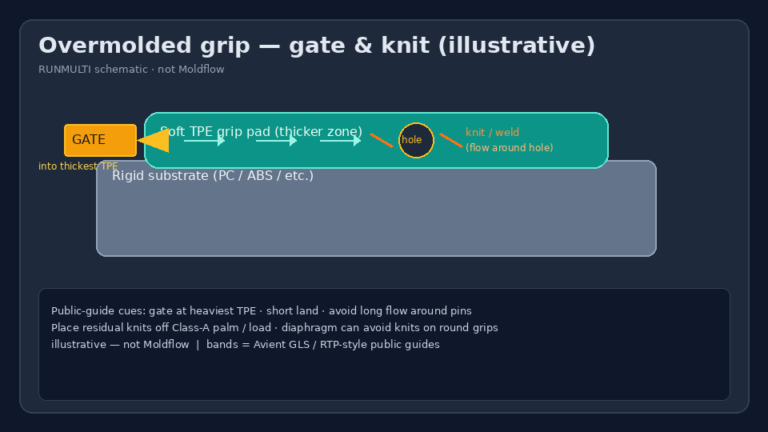
- Wall and gate — substrate walls that survive second-shot heat/pressure; gates that do not jet into the bond interface.
- Cosmetics — knit/witness lines at the soft/hard boundary; grip texture.
- Tooling method (2K) — rotary platen vs core-back vs robot transfer.
- Validation — peel, leak, or torque tests defined before T1.
A full DFM pass goes deeper (draft, cooling, ejection, steel, cavity layout). This list is the multi-material core that prevents expensive surprises.
How RUNMULTI approaches the choice
RUNMULTI designs multi-material tools in Creo and Siemens NX, with 20+ years of mold engineering behind the review. We do not push 2K when overmolding fits better commercially, and we do not green-light a resin pair on optimism. Bonding, shut-off, and volume drive the recommendation — then the tool method follows.
Next step: paid DFM review
Order a paid Independent DFM Review before tooling. We check draft, walls, gates, shut-offs, material pairing, and whether 2K or overmolding fits your volume — then credit the review fee toward your mold order when you proceed.
RUNMULTI — Xiamen, China. Custom injection molds, two-shot (2K) molding, and overmolding for EU & US brands.