Rotary Platen vs Core-Back vs Robot Transfer: Choosing a 2K Tooling Method
An RFQ that only says "2K mold" without naming the transfer method is how programs get the wrong press, the wrong quote, and a late redesign. Rotary platen, core-back, and robot transfer all put a second resin on a first shot — but they ask different things of geometry, equipment, and cycle.

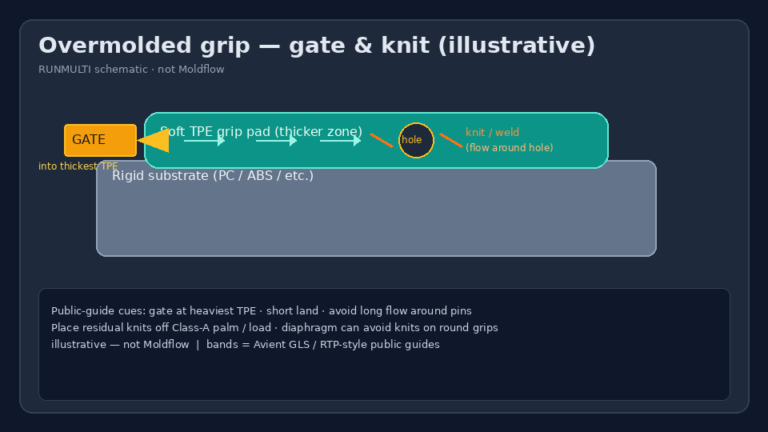
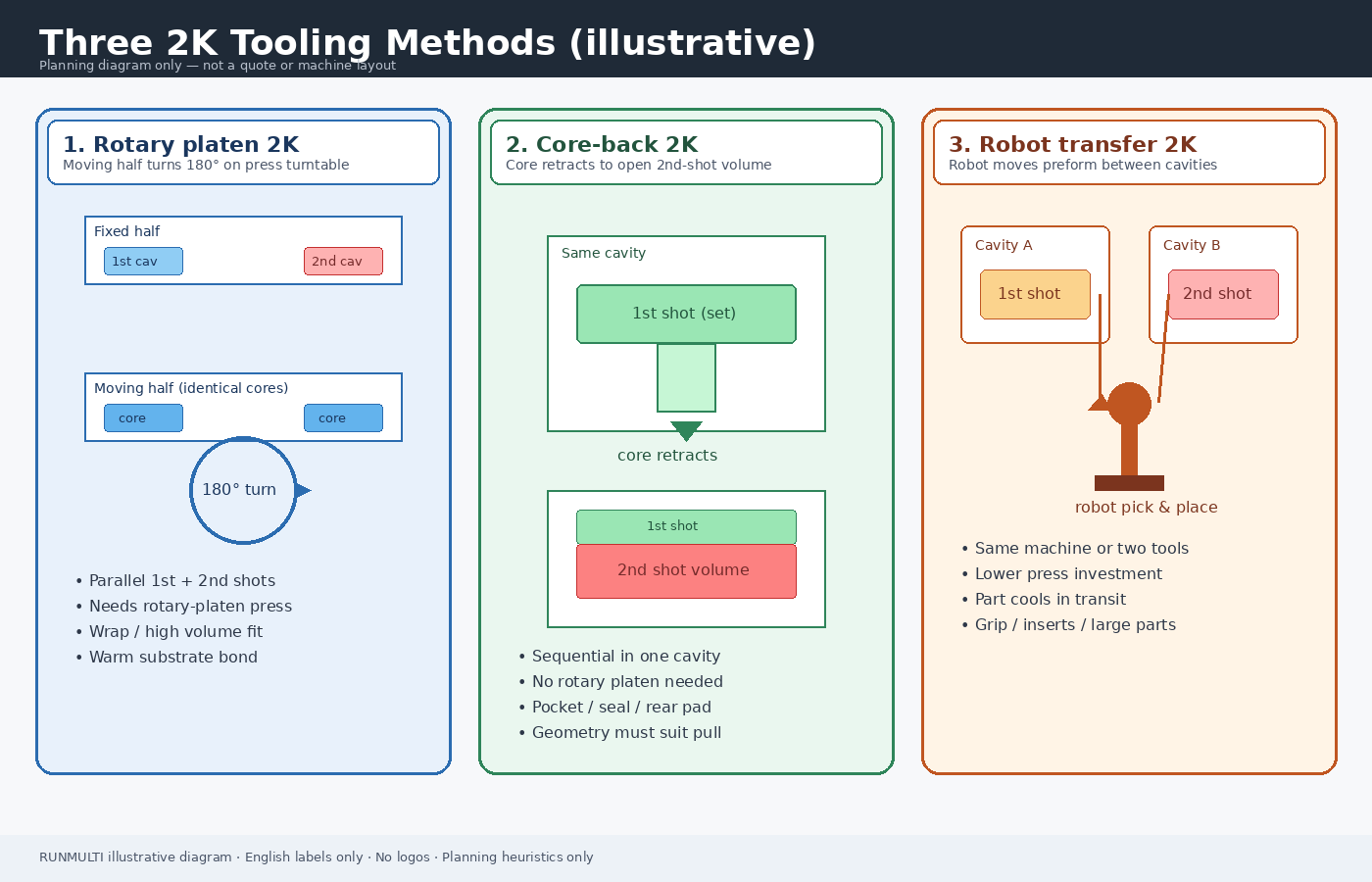
RUNMULTI illustrative diagram: rotary platen, core-back, and robot transfer. Planning heuristics only, not a quote.
This article is for EU and US product and sourcing engineers buying two-shot molds from China who need a shared vocabulary before steel. Method descriptions below follow public OEM and design-guide language (Protolabs, KraussMaffei, industry mold pages). Relative cost and "when we lean" notes are shop heuristics / 【估算】 — planning only, not RUNMULTI lab data.
What each method is
Rotary platen (rotary table / turntable)
A turntable on the moving platen carries the moving mold half. After the first shot, the mold opens, the half turns (often 180°), and the warm preform lines up with the second-shot cavity while a new first shot fills the empty station. KraussMaffei describes turntable technology for unilateral overmolding at higher quantities; Protolabs calls the family rotational overmolding. Moving-half cores at both stations must be identical; the fixed half holds the different first- and second-shot cavities.
Core-back (core-pull / sliding split second-shot volume)
Nothing indexes the part out of the cavity. A movable core or sliding split blocks volume during the first shot, then retracts to open the pocket the second material fills — same cavity, sequential shots. Protolabs notes core-back suits very specific linear geometries. Public mold pages commonly list seals, windows, planar buttons, and rear soft pads. Cycle is sequential — often longer than a parallel rotary cycle (shop heuristic).
Robot transfer (transfer / pick-and-place between cavities)
A robot (or handling unit) picks the first-shot preform and places it into a second cavity — same mold or a second tool — while the next substrate can start in the first cavity. KraussMaffei lists transfer when the preform must be free on both sides; Protolabs describes robotic transfer overmolding. Tooling and press investment can be lower than a rotary cell, but the part cools in transit, which can weaken chemical bond unless the pair and process are designed for it (public bonding caution + shop heuristic on grip/nest design).
Comparison (estimates labeled)
| Factor | Rotary platen | Core-back | Robot transfer |
|---|---|---|---|
| How part moves | Moving half turns on press turntable | Core retracts; part stays | Robot moves preform |
| Cycle / automation | Parallel 1st+2nd stations typical | Sequential in one cavity | Handling time + cool time |
| Geometry fit | Wrap, grips, two-color housings | Pocket / rear volume / seal bead | Both sides free; inserts; large / special |
| Tooling complexity | Dual stations; centering critical | Core/slide + seal at pull face | Transfer nests + grip features |
| Press needs | Dual injection + compatible rotary platen | Dual injection; no rotary platen required | Often standard dual or two presses + robot |
| Typical failure modes (heuristic) | Off-center turn damage; crush/support on 2nd shot | Flash at pull face; geometry won't open clean pocket | Nest mark; cool bond loss; misplace |
【估算】 / planning only: relative steel and cell cost usually ranks robot/simple transfer lower up-front, core-back mid when geometry fits, rotary highest when a turntable press is required — confirm against your supply-base machines.
Protolabs states automated two-shot methods layer onto a warm substrate and tend to pay off at high volume — typically more than 10,000 pieces, often 100,000+. Use that as a published planning band, not a hard break for every China quote.
When we lean which way (engineer heuristics)
Labeled shop heuristics, not guarantees:
- Lean rotary when annual volume is sustained, the second material wraps or needs a second station geometry, and the molder has a matching rotary-platen press. Warm-on-warm bond and one finished part per cycle are the upside.
- Lean core-back when the second shot is a defined pocket one straight (or planned) core motion can open — seal beads, local soft pads, planar windows — and you want to avoid rotary equipment. If the soft must fully encircle a 3D grip, core-back usually fights you.
- Lean robot transfer for lower volume, design still moving, very large parts, metal inserts, or when first and second process windows differ sharply. Budget extra bond validation if the substrate cools before the second shot.
Also ask what presses your China shortlist actually runs. A perfect rotary design is useless if nobody has a matching turntable (shop heuristic).
What to put on the RFQ so suppliers quote the same thing
Do not stop at "2K." Spell out:
- Preferred transfer method — or "open: propose rotary / core-back / robot with reason."
- Resin pair (grade names if locked) and whether bond is chemical, mechanical, or both.
- Whether the second shot wraps or sits in a rear/local pocket.
- Annual volume and expected design-freeze risk.
- Cosmetic / seal critical edges and where flash is unacceptable.
- Press constraint — must run on rotary platen? dual barrel only? two standard presses OK?
- Inserts — metal or plastic substrate from another tool?
That list alone prevents apples-to-oranges quotes (one shop prices core-back, another a rotary cell).
DFM checklist before steel
| Check | What good looks like |
|---|---|
| Method named | Rotary / core-back / robot chosen with geometry + press reason |
| Station / core rules | Rotary: identical moving cores; fixed 1st vs 2nd cavities clear |
| Core-back pocket | Pull direction opens full 2nd volume; seal land defined |
| Transfer grip | Robot has a grip zone that is not a Class-A face |
| Bond plan | Warm-process vs cool-transfer called out; peel/leak test planned |
| Shut-off | Survives index or seats against substrate; no feathered soft edge |
| Centering / crush | Rotary: mold on turntable center; 2nd-shot support under crush |
| Steel-safe | Room to tweak shut-off or nest after T1 where possible |
How RUNMULTI reviews the method
RUNMULTI (Xiamen RUNMULTI Co., Ltd) designs and builds multi-material molds, with transfer method, shut-off, and resin pairing reviewed in Creo and Siemens NX before steel is cut, backed by 20+ years of mold engineering. We would rather argue rotary vs core-back in CAD than discover the press cannot turn the tool after the PO.
Next step: a paid DFM review
If your RFQ still says only "2K," order an Independent DFM Review before freeze. Tiers: Quick Check $195 · Standard $595 · 2K / Overmold Pro from $1,250. The Pro review covers tooling method, bonding, shut-off, and a rough tool-cost range discussion. The review fee is credited toward your mold order if you place the tool order within 10 business weeks of review delivery, and the report is yours to take to any supplier.
Or contact us with STEP files, resin pair, annual volume, and whether the second shot wraps or sits in a pocket.
RUNMULTI — Xiamen, China. Custom injection molds, two-shot (2K) molding, and overmolding for EU & US brands.