Draft Angle Guidelines for Textured and Soft-Touch Parts
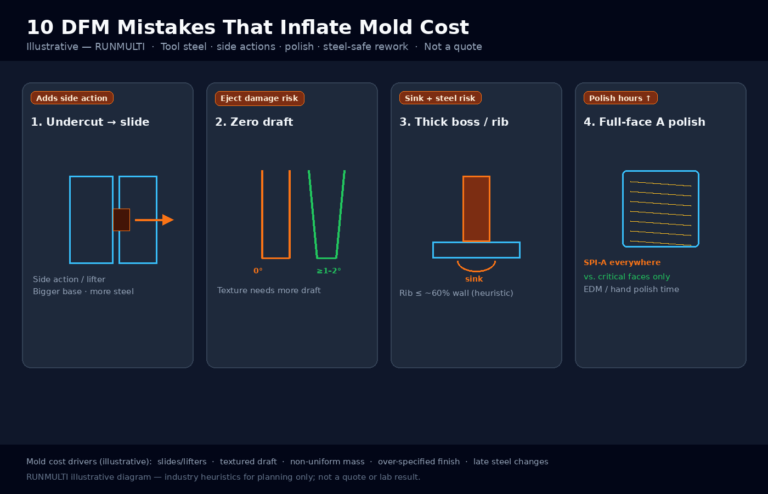
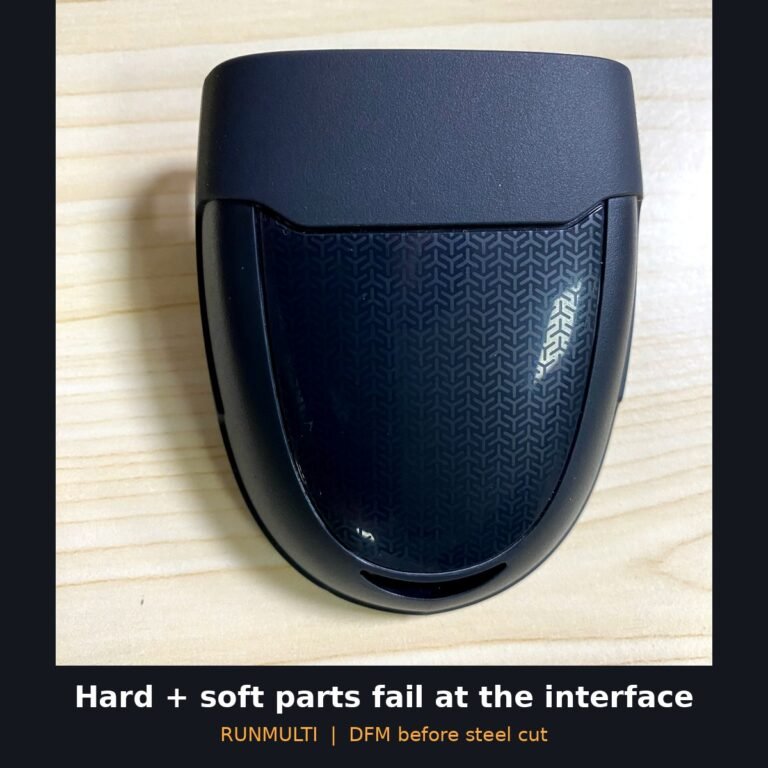
“Give it 1° everywhere” is the most common draft note we see on EU and US drawings — and the note that fails first once texture or a soft-touch TPE lands on a vertical wall. Drag marks, soft-edge peel, and pins punching a soft pad are usually draft never sized for the finish or elastomer.

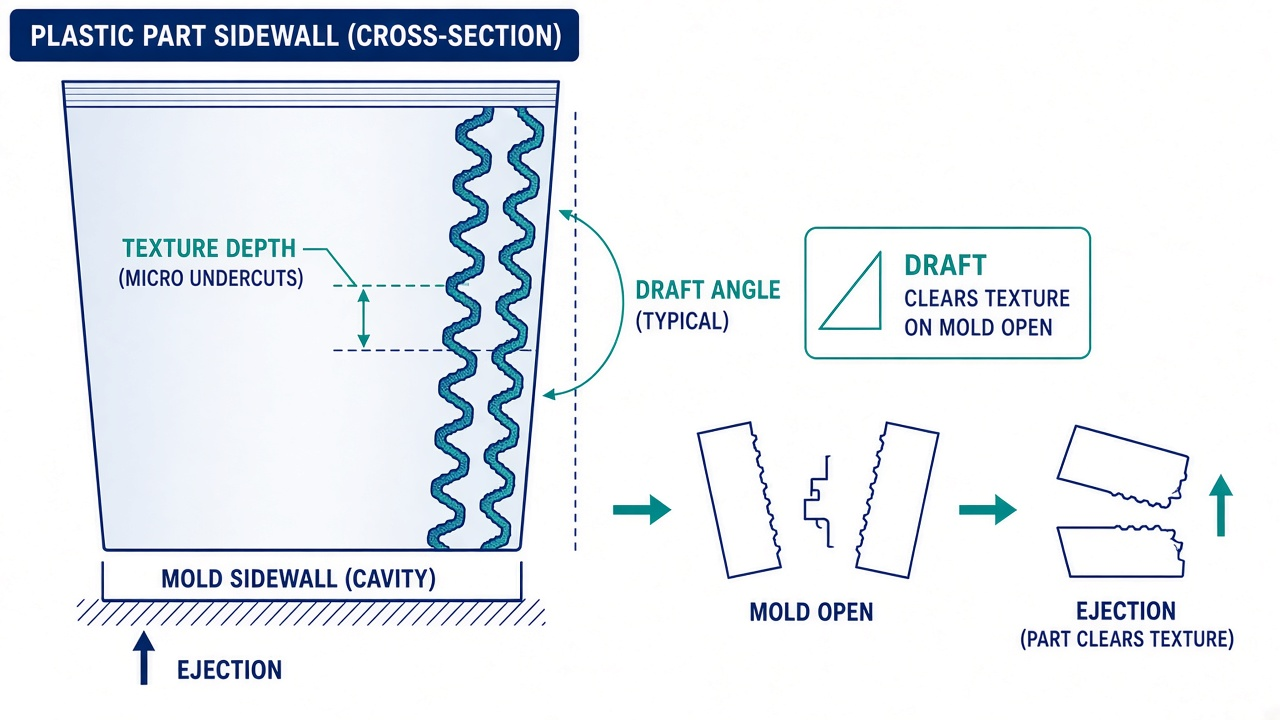
RUNMULTI illustrative section: draft clearing texture micro-undercuts on mold open and ejection. Planning heuristics only, not a quote.
This article is for product and sourcing engineers buying overmold tooling or two-shot molds who need starting ranges before steel is cut. Numbers below are published design-tip and supplier guidelines, not RUNMULTI lab data. Confirm with your texture house and resin datasheet.
Why “1° everywhere” fails on texture and soft-touch
On a polished wall, draft mainly fights shrink grip. On a textured wall, pits and peaks act like micro-undercuts. As the mold opens, the part must clear that roughness before it can slide. Soft-touch makes it worse: a soft TPE can stretch, tear, or drag across texture that rigid ABS would only scuff. Ejection strategy (stripper, air, slow eject) matters as much as the angle — a shop heuristic, not a lab claim — but neither saves a zero-draft leather-grain wall.
How texture creates micro-undercuts
Texture is etched, blasted, or lasered into the cavity. Every valley is a tiny undercut relative to open. Draft gives the part a short travel to clear those valleys before full ejection. Without it you get drag lines, smeared texture, soft overmold that peels, and over-stressed ejector pins. Draft for texture is clearance for a 3D surface — not a cosmetic preference.
Starting ranges from public guides
No single angle fits every resin, depth, and ejection plan. Public guides give useful planning windows; verify with the texture plaque and your molder.
General and light / medium texture (Protolabs)
Protolabs advises roughly 0.5° on all vertical faces, notes that 1–2° works well in most situations, and calls for about 3° for light texture (PM-T1) and 5° or more for medium/heavy texture (PM-T2). Source: Protolabs — Improving Part Moldability with Draft.
Extra draft vs texture depth (Stratasys Direct)
Stratasys Direct’s injection-molding guidelines cite about 1.5° of additional draft per 0.025 mm (0.001 in) of texture depth, on top of normal draft. Their published leather-like example around 0.125 mm (0.005 in) depth points to roughly 7.5° minimum — a published guideline, not a RUNMULTI test. Source: Stratasys Direct Injection Molding Design Guidelines PDF.
Deeper Mold-Tech-style textures (Protolabs)
For deeper chemical or laser textures, Protolabs recommends roughly 1° of draft per 0.0005–0.0006 in (about 0.013–0.015 mm) of texture depth — often about 6–7° for typical wood or leather. Source: Protolabs — Mold Texture Standards and Finishes.
Soft-touch / long draws and overmold faces
Avient’s overmolding part-design article calls for 3°–5° draft on long draws. Alpine Mold’s overmold guide cites about 2°–5° as common on overmold surfaces parallel to ejection, with softer grades, deeper textures, and taller walls needing more. Sources: Avient — Overmolding: Part Design; Alpine Mold — Overmolding Design Guide.
Smooth TPE tables ≠ texture add-on
Some TPV/TPE supplier tables list very small draft for smooth walls — for example 0.25–0.5° per side for certain grades. Those are starting points for smooth release, not a substitute for the texture add-on above. Soft pad plus Mold-Tech on the same wall: size draft for texture first, then review hardness and ejection.
| Situation | Published starting band (verify) |
|---|---|
| Smooth vertical faces | ~0.5° advised; 1–2° typical (Protolabs) |
| Light texture (PM-T1 class) | ~3° (Protolabs) |
| Medium/heavy (PM-T2) | ~5°+ (Protolabs) |
| Per texture depth | ~+1.5° per 0.025 mm (Stratasys Direct) |
| Leather-like ~0.125 mm | ~7.5° cited (Stratasys Direct) |
| Wood/leather Mold-Tech depth | often ~6–7° (Protolabs) |
| Soft-touch long draws | 3°–5° (Avient) |
| Overmold faces // eject | ~2°–5°, more if soft/deep/tall (Alpine Mold) |
Soft-touch specific: angle is only half the story
Even with healthy draft, soft grades hang if ejectors push only on the elastomer. Shop heuristics (not lab claims): put ejector load on the rigid substrate; consider stripper plate or air assist for thin soft skins; slow the first millimetres of eject on deep texture; avoid pin tips that dimple a soft A-surface; watch wraparound soft edges that create undercuts. Draft clears the texture; ejection keeps the soft skin intact.
2K / overmold: draft both cavities
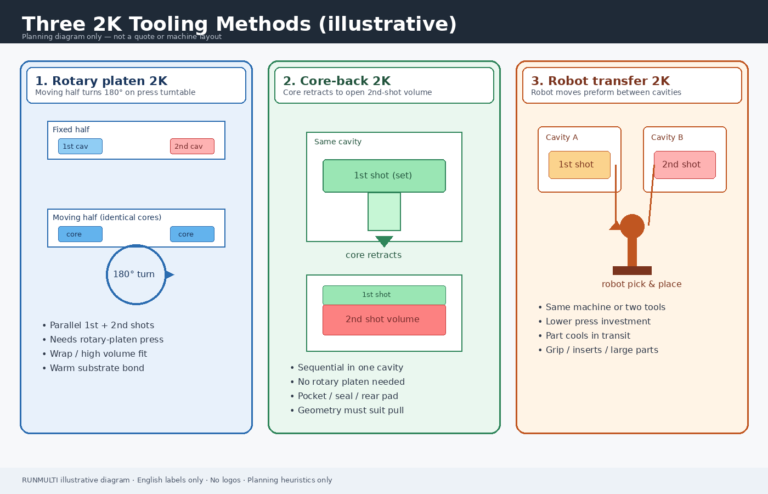
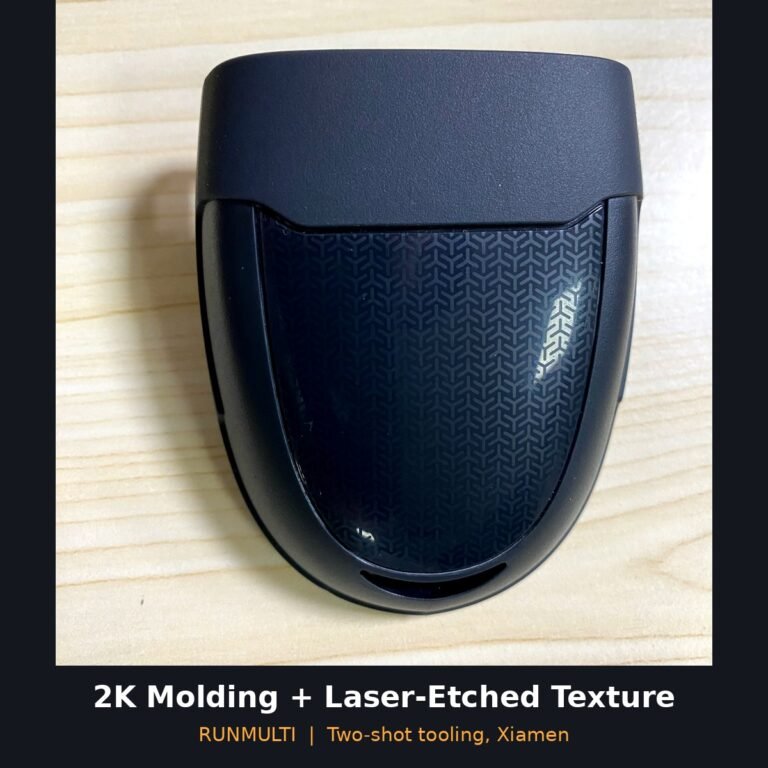
On two-shot and overmold parts, draft is a pair of problems. The textured rigid substrate still needs texture draft, or the first shot scrapes before the second shot runs. The soft second shot needs its own draft on tall grip faces and long draws. A common risk is soft edge + texture on the same wall with skimpy draft: flash or peel at the shut-off plus drag on the rigid face. In CAD we check both shots, whether texture stops short of the seal land, and whether the soft edge has a defined step — not a feathered exit on a textured vertical wall.
What we check in DFM before steel
| Check | What good looks like |
|---|---|
| Texture vs draft | Texture depth/code named; draft matches public guide + supplier plaque |
| Soft walls // eject | Draft in the 2°–5°+ planning band for height/hardness |
| Soft + texture same wall | Soft edge and texture do not share one skimpy taper |
| Both shots drafted | First-shot substrate and second-shot soft cavity each reviewed |
| Ejection plan | Load on rigid substrate; stripper/air/slow eject where needed |
| Shut-off land | Seal land not heavily textured; soft edge has a step/groove |
| Steel-safe | Room to add draft or lighten texture after T1 where possible |
| Drawing notes | Finish zones color-coded; no “texture everywhere + 0.5° everywhere” |
How RUNMULTI reviews draft for texture and soft-touch
RUNMULTI (Xiamen RUNMULTI Co., Ltd) designs and builds multi-material molds, with draft, texture, and soft-edge strategy reviewed in Creo and Siemens NX before steel is cut, backed by 20+ years of mold engineering. We would rather argue about 2° vs 5° in CAD than polish drag marks out of a textured cavity after T1.
Next step: a paid DFM review
If your part has Mold-Tech or bead-blast callouts, soft-touch grips, or both on the same wall, order an Independent DFM Review before RFQ freeze. Tiers: Quick Check $195 · Standard $595 · 2K / Overmold Pro from $1,250. The Pro review covers draft vs texture depth, soft-wall ejection, shut-off, and material pairing. The review fee is credited toward your mold order if you place the tool order within 10 business weeks of review delivery, and the report is yours to take to any supplier.
Or contact us with STEP files, texture codes (or depth), soft/hard resin pair, and annual volume.
RUNMULTI — Xiamen, China. Custom injection molds, two-shot (2K) molding, and overmolding for EU & US brands.