TPE Overmolding Material Compatibility: Which Substrates Bond?
Soft grip on a hard housing fails for one reason more than any other: the elastomer and the substrate were never a matched pair. TPE overmolding compatibility is chemistry, surface condition, and geometry — decided before steel is cut.
This guide maps which rigid plastics typically accept TPE, TPU, or TPV overmolds, and when you must design for mechanical lock instead of hoping the melt sticks. It is written for EU and US product and manufacturing engineers.

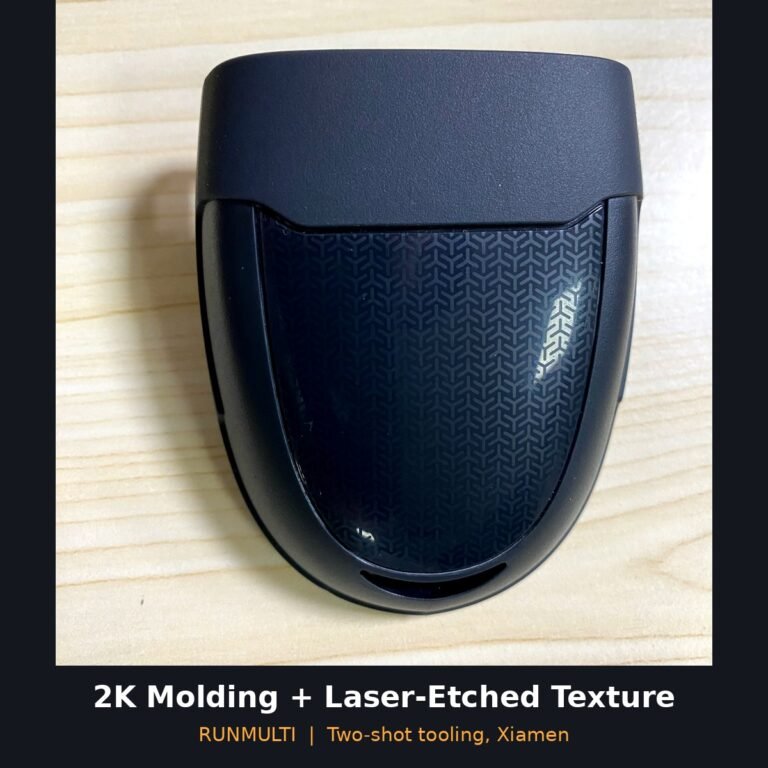
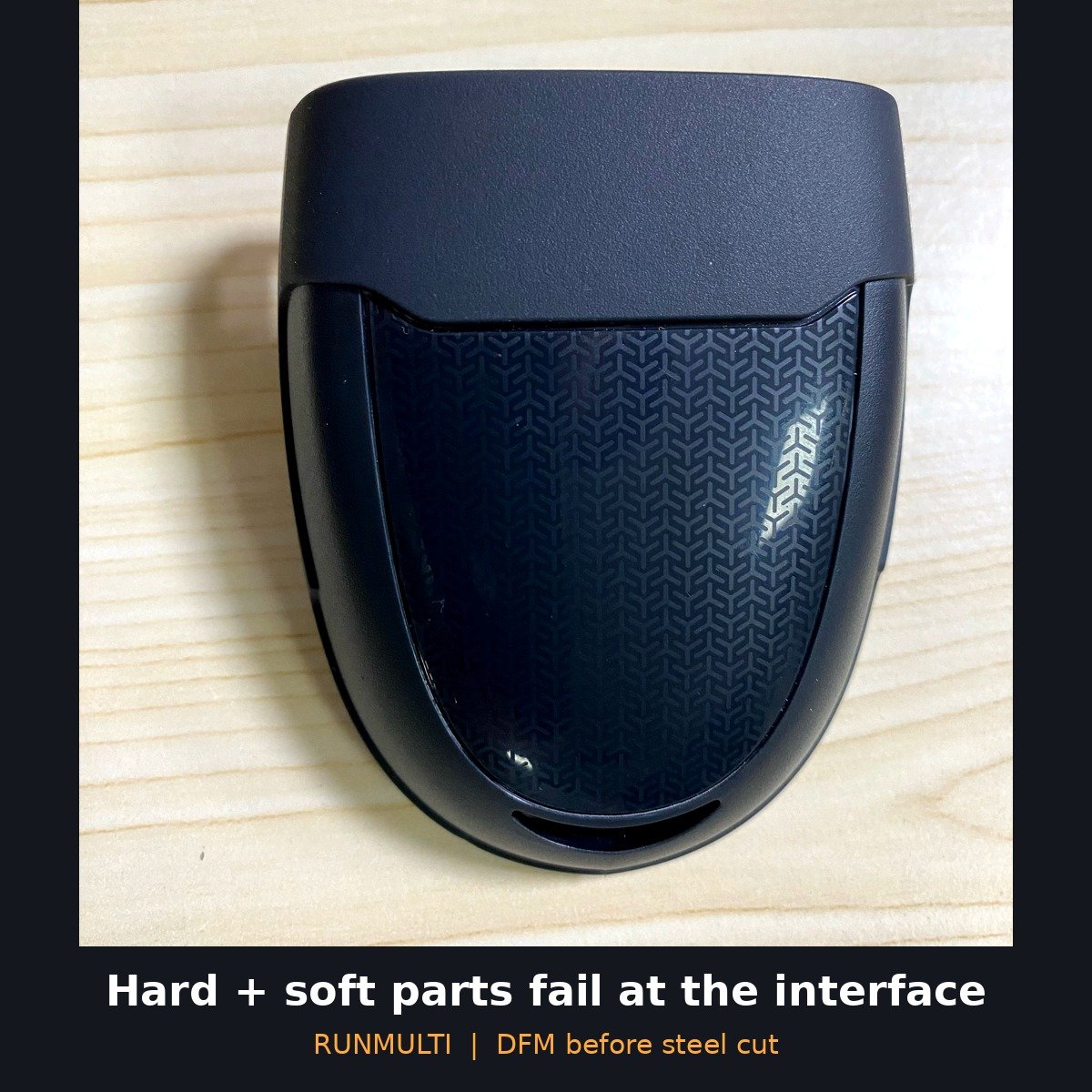
Hero: RUNMULTI project photo (client marks redacted). Soft/hard overmold context.
At RUNMULTI, a Xiamen mold maker focused on overmolding and two-shot (2K) molding, we review resin pairs in Creo or Siemens NX before the tool layout is frozen. Notes below reflect common industry pairing practice — not proprietary lab statistics.
Chemical bond vs mechanical bond
Two mechanisms keep a soft layer on a rigid part.
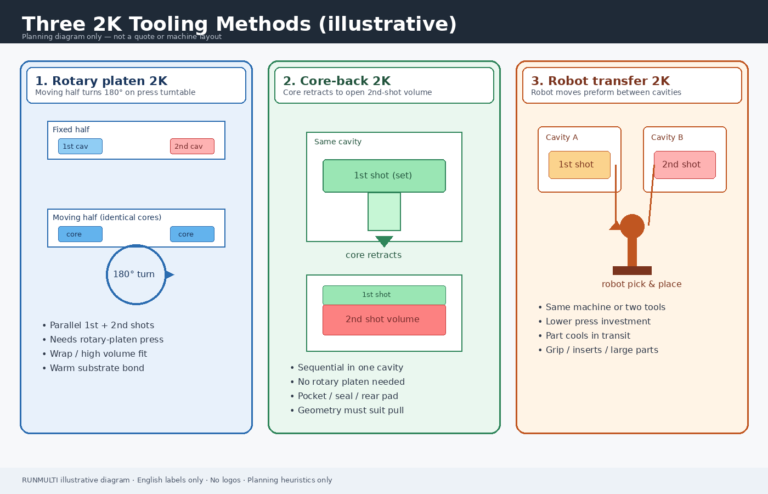
Chemical bonding happens when the overmold melt wets the substrate and polymer chains interdiffuse at the interface. It needs a compatible grade, enough heat for wet-out, and a clean surface. Warm-on-warm two-shot molding helps because the first shot is still hot. Overmolding onto a cool insert weakens that path — the same grades can still work, but process window and cleanliness matter more.
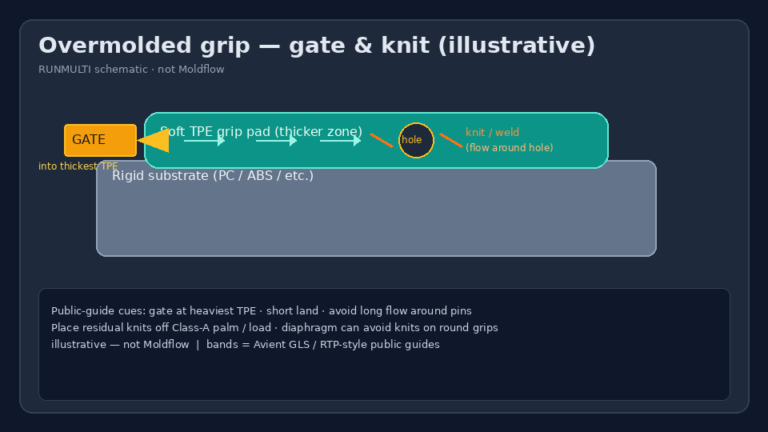
Mechanical bonding uses geometry: through-holes, dovetails, undercuts, wrap-arounds, grooves, and a raised substrate lip that buries the soft edge so peel cannot start. Industry guides treat mechanical locks as insurance when chemical adhesion is marginal — and as the primary plan for low-surface-energy resins such as POM or PE. For safety-critical grips or seals, design interlocks that can carry the load if the interface peels.
Substrate map: what usually bonds to TPE
Compatibility is grade-specific. A datasheet “bondable to ABS” claim is a starting shortlist, not a process guarantee. Public supplier charts and compounder guidance commonly show this pattern:

Illustrative planning chart by RUNMULTI — industry heuristic, not lab-certified ratings. Verify every pair with the resin maker and a peel plan.
PP + TPE / TPV — the established standard
Polypropylene with olefinic TPE or TPV is the most common hard/soft pair. Industry writing often calls PP–TPE an established standard because polarity matches well with SEBS-based and TPV systems. TPU on PP is usually weak chemically — plan interlocks or switch the soft grade.
Design cue: name the PP and TPE grades before tooling; mold release and fingerprints still kill an otherwise good pair.
ABS + TPE · PC + TPE · PC/ABS + TPU
ABS and polycarbonate are polar enough that specialty overmold TPEs and many TPUs form usable chemical bonds. Industry compatibility tables often mark ABS/PC with bonding-grade TPEs or TPU as chemical, while olefinic TPV on ABS/PC is typically mechanical-only.
RUNMULTI’s common quote pairs include PC + TPE, ABS + TPE, and PC/ABS + TPU.
Design cue: match a PC- or ABS-bonding TPE (or TPU) to the exact substrate grade; fillers and flame-retardant packages change wetting.
PA6 / PA66 + TPE (adhesion-modified)
Nylon is bondable but unforgiving. Standard SEBS grades often fail on PA. Industry compounders specify amide-compatible TPE series for PA6/PA66 — with or without glass. Glass-filled nylon is harder still: fibers at the surface reduce bondable polymer area, so peel strength drops even with the “right” grade.
We commonly quote PA + TPE (adhesion-modified grades) for this reason. For GF-PA grips or seals, combine a nylon-bonding soft grade with through-holes or undercuts.
Design cue: dry nylon to the resin supplier’s moisture spec before the overmold shot; wet PA is a frequent root cause of voids and weak interfaces.
POM, PE — plan mechanical lock first
Acetal (POM) and polyethylene sit at the difficult end of industry charts. Low surface energy means almost nothing forms a reliable chemical bond to POM; PE needs dedicated bonding grades or interlocks. For mold design, assume mechanical retention from day one on POM substrates.
Quick pairing summary (industry heuristic)
| Substrate | Typical soft options | Bond strategy (industry guides) |
|---|---|---|
| PP | TPE (SEBS), TPV | Chemical with matched olefinic grades |
| ABS / PC / PC/ABS | Specialty TPE, TPU | Chemical with bonding grades; TPV often mechanical |
| PA6 / PA66 (incl. GF) | Amide-compatible TPE; some TPU | Specialty grades + interlocks for GF |
| POM / PE | Any soft resin | Mechanical primary; specialty PE grades only where proven |
This table is a planning heuristic from public supplier and molder guides — verify every pair with the resin maker and a peel plan on your geometry.
Why “compatible” pairs still peel
Even a matched pair fails when the interface is contaminated or cold.
- Oils, mold release, fingerprints on stored substrates block wet-out — especially in pick-and-place overmolding.
- Melt too cold at the far end of the flow path: the soft shot never softens the substrate surface.
- Moisture in hygroscopic substrates (PA, some PC blends) flashes at the interface.
- Exposed soft edges with no substrate lip: peel starts at the edge and propagates.
- 2K vs cold insert: warm-on-warm favors chemical bond; cold-insert overmolding needs stricter grade match and cleaner handling.
Define a peel or pull test on first samples and read the failure mode. Cohesive tear in the TPE usually means the chemistry is working; clean adhesive separation means the bond is marginal — redesign grade, process, or geometry before production steel. Industry peel methods (ASTM D6862-style 90° peel, DIN ISO 813-2) are useful references; your geometry still needs its own criteria.
DFM checklist before you lock grades
- Name both grades — substrate and overmold SKUs, not just “ABS + TPE.”
- Write the bond strategy — chemical primary, mechanical primary, or both.
- Shut-off land — continuous, supported; soft flash is a peel starter.
- Interlocks — holes, dovetails, wrap, buried edges where adhesion is weak.
- Walls and gates — substrate survives second-shot heat/pressure; gate does not jet along the bond face.
- Cleanliness / drying — especially for PA and for cold-insert overmold routes.
- Validation — peel, leak, or torque criteria defined before T1.
For multi-material parts, resin pairing and shut-off are the items that most often wreck timelines.
How RUNMULTI reviews TPE pairs
RUNMULTI (Xiamen RUNMULTI Co., Ltd) designs multi-material tools in Creo and Siemens NX, with 20+ years of mold engineering behind the review. Soft/hard materials we routinely discuss include PP, ABS, PC, PC/ABS, PA6/PA66 (including glass-filled), POM, PMMA, PE, PBT, TPE, TPU, and TPV.
We do not green-light a pair on optimism. Bonding chemistry, shut-off, and whether overmolding or 2K fits your volume drive the recommendation. Common quote pairs include PC + TPE, ABS + TPE, PC/ABS + TPU, PP + TPE/TPV, and PA + adhesion-modified TPE.
Next step: paid DFM review
Order a paid Independent DFM Review before tooling. Tiers: Quick Check $195 · Standard $595 · 2K / Overmold Pro from $1,250. We check draft, walls, gates, shut-offs, and whether your TPE–substrate pair needs chemical grades, mechanical locks, or both. The review fee is credited toward your mold order if you place the tool order within 10 business weeks of review delivery.
Or contact us with STEP files, target resins, and annual volume.
RUNMULTI — Xiamen, China. Custom injection molds, two-shot (2K) molding, and overmolding for EU & US brands.