10 DFM Mistakes That Make Injection Molds Expensive
Most “cheap mold” surprises are not steel-grade tricks. They are injection molding DFM mistakes that force side actions, oversized bases, mirror polish on faces nobody sees, and steel cuts that cannot be walked back after T0. This list is for EU and US product, manufacturing, and sourcing engineers who buy China tooling — framed around mold cost drivers, not only piece-part cosmetics.

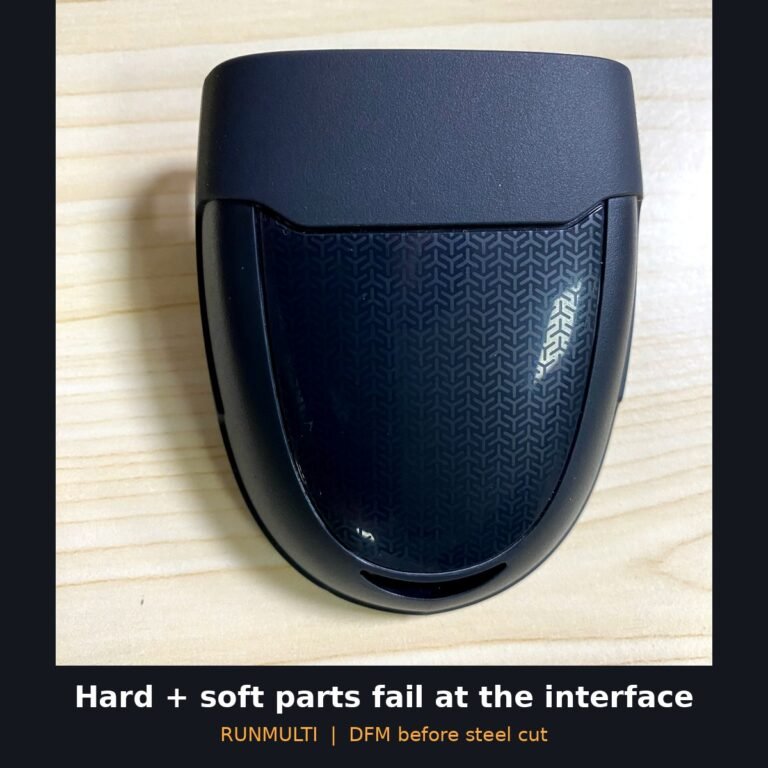
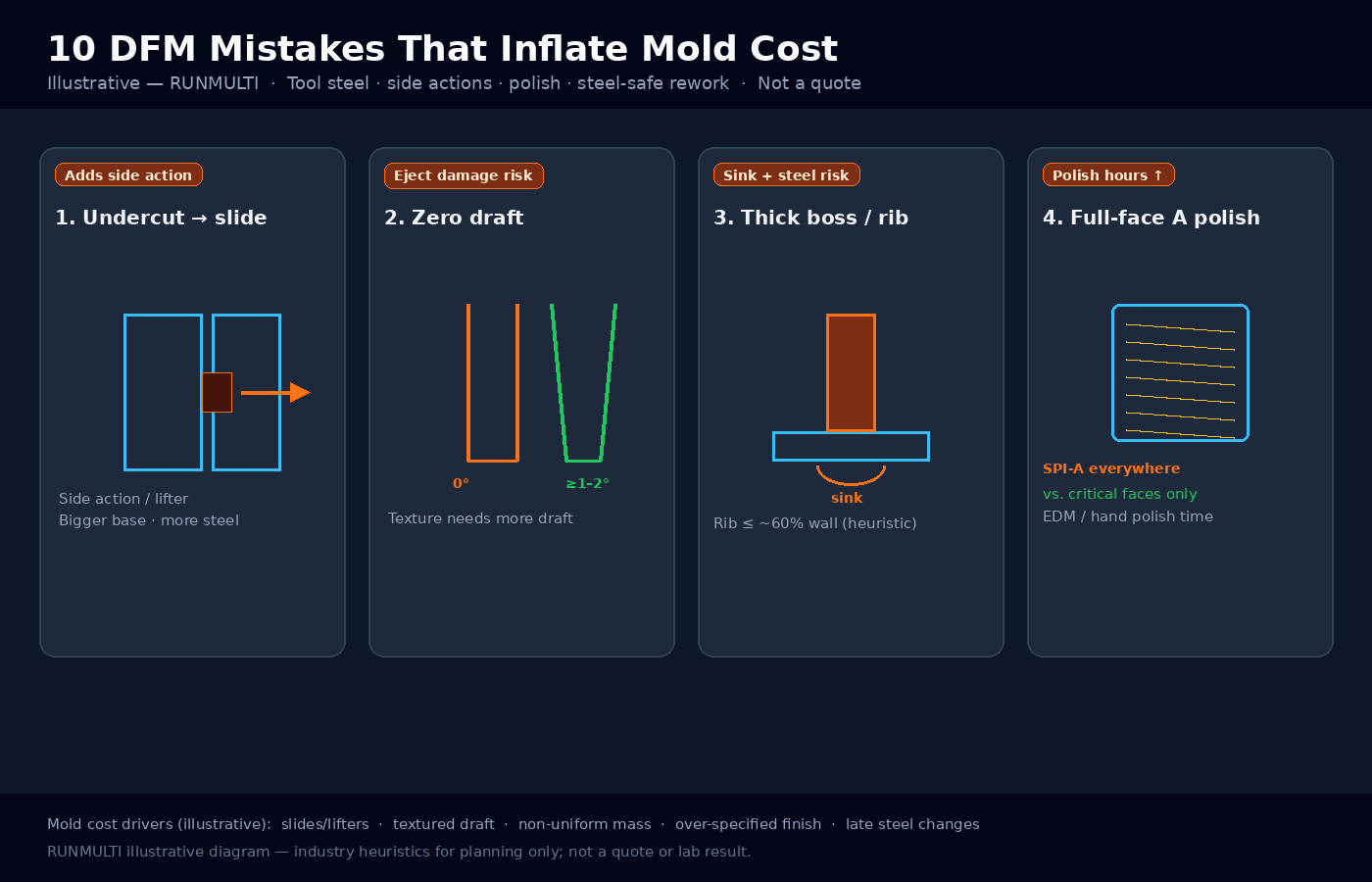
Hero: RUNMULTI illustrative diagram — slides, draft, thick bosses, and over-specified polish as planning heuristics (not a quote).
At RUNMULTI, a Xiamen mold maker focused on overmolding, two-shot (2K) molding, and independent DFM review, we mark these issues in Creo or Siemens NX before RFQ freeze. Notes below are industry-typical heuristics — not proprietary lab statistics.
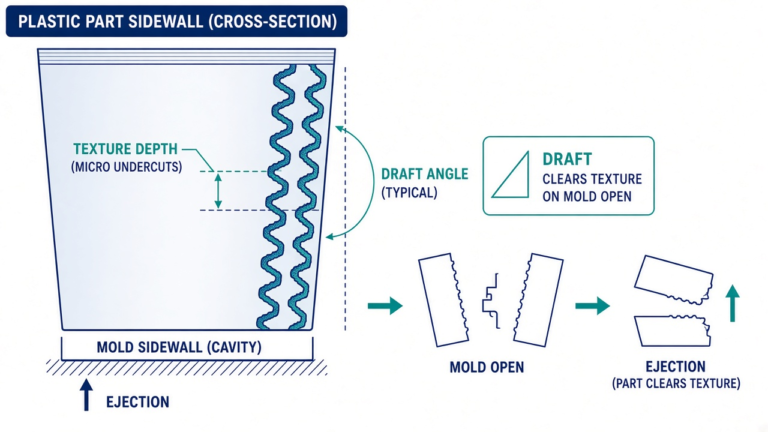
1. No draft / insufficient draft (especially textured)
Zero-draft walls hang on the core, scuff texture, and overload ejector pins. Industry guides commonly cite about 1–2° for general surfaces, more for shut-offs, and extra draft for texture (often cited in the 3–5°+ range as a planning heuristic — verify with your texture supplier).
Mold cost: deep undrafted cavities need harder machining and polish cleanup; textured faces without draft fail at T1.
2. Non-uniform / abrupt wall thickness
Thick-to-thin jumps cool at different rates — sink, warp, and voids follow. Public molder guides often keep thinner sections from dropping below roughly 40–60% of neighboring walls and use gradual transitions instead of steps.
Mold cost: longer packing fights in molding, plus cavity rework when warp exceeds print after T0/T1.
3. Unnecessary undercuts → slides and lifters
Every true undercut that cannot eject in the open/close direction usually needs a slide, lifter, collapsible core, or hand insert. That means a larger mold base, more components, longer build, and slower cycles.
Mold cost: redesign first — pass-through cores, parting-line moves, bump-offs on flexible parts — before you accept a cam pack. Budget real undercuts deliberately; do not discover them in the quote fine print.
4. Over-specified cosmetic texture / SPI finish everywhere
Mirror SPI-A and heavy textures belong on visible A-surfaces — not the whole cavity. High polish and custom texture add EDM, hand work, and texture-vendor lead time.
Mold cost: polish only the faces that need it. Call out finish zones on a color-coded print.
5. Tight tolerances everywhere instead of critical-only
Drawing every dimension at “precision” forces tighter steel fits and inspection overhead. Plastics already move with shrink, moisture, and glass orientation.
Mold cost: reserve tight bands for fits, seals, and datums. Label critical dims before RFQ.
6. Sharp corners / missing radii
Sharp inside corners are stress raisers and poor flow paths. They also mean sharp steel edges that chip or need EDM when cutters cannot reach. Industry radii heuristics often start near ~0.5× wall on inside corners (planning guidance).
Mold cost: missing fillets show up as electrode time, polish time, and cracked parts in the field.
7. Ribs too thick or too tall
Ribs should stiffen without recreating a thick wall. A widely cited heuristic keeps rib thickness near ~50–60% of the nominal wall (verify for your resin). Tall, thin steel blades for deep ribs are fragile.
Mold cost: show-face sink, weld lines at rib roots, and cavity steel that is expensive to machine and easy to damage.
8. Late CAD changes after steel is cut
Steel-safe means you can still remove metal (add plastic). Adding metal back into a finished cavity is often insert rework — or a new cavity. Late logo moves, wall thickeners, and gate relocation after T0 burn the tooling budget fast.
Mold cost: freeze functional geometry before hard milling. Treat “small CAD tweaks” as change orders until proven steel-safe.
9. Ignoring shut-off / parting line / gate for 2K or overmold edges
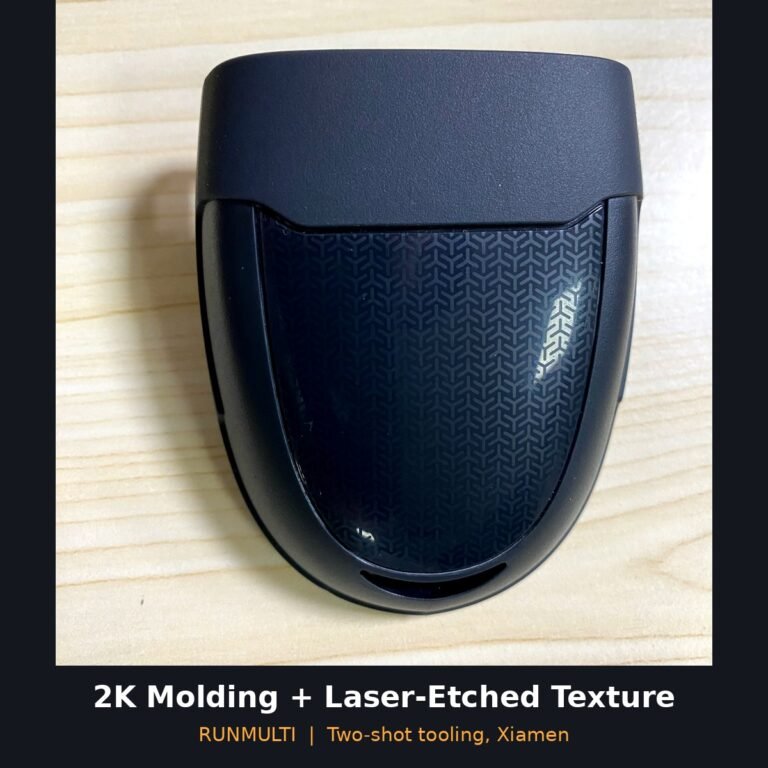
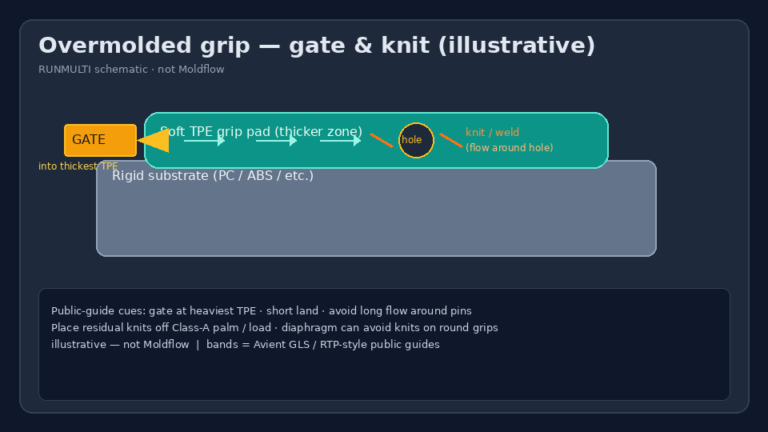
Multi-material parts fail at the soft edge: flash, peel starters, and gates that jet along the bond face. Shut-off lands need continuous, supported contact. For overmolding and 2K, bond strategy and shut-off belong in DFM — not after the first soft-shot flash.
Mold cost: second-shot tooling changes and extra T1/T2 loops. Soft flash is cheap to ignore in CAD and expensive in steel.
10. Skipping independent DFM before RFQ freeze
Sending the same STEP to five mold shops without a manufacturability pass invites five interpretations of draft, parting, and side actions — and five prices that are not comparable.
Mold cost: the cheapest quote often assumes the most optimistic actions. Finding missing draft or a buried undercut after PO is how projects lose weeks.
Quick mold-cost checklist
| Mistake | Typical mold-side cost driver |
|---|---|
| Poor draft / texture draft | Eject damage, polish, texture scrape |
| Abrupt walls | Warp fights, cavity rework |
| Avoidable undercuts | Slides, lifters, larger base |
| Finish everywhere | Polish / texture hours |
| All-tight tolerances | Fit-up steel + inspection |
| Sharp corners | EDM, chip risk, stress |
| Fat / tall ribs | Sink + fragile cavity steel |
| Late CAD after cut | Non-steel-safe rework |
| Weak 2K/overmold shut-off | Soft flash, peel, 2nd-shot changes |
| No DFM before RFQ | Quote mismatch, T0 surprises |
How RUNMULTI approaches these reviews
RUNMULTI (Xiamen RUNMULTI Co., Ltd) designs and builds custom molds with a focus on multi-material work. Reviews run in Creo and Siemens NX, backed by 20+ years of mold engineering. We do not invent certifications or anonymous “saved $X” case stats — the point of DFM is catching the ten items above while changes are still plastic in CAD.
Next step: paid DFM review
Order a paid Independent DFM Review before you freeze the RFQ. Tiers: Quick Check $195 · Standard $595 · 2K / Overmold Pro from $1,250. We check draft, walls, undercuts/actions, finish zones, critical tolerances, ribs, steel-safe risk, and multi-material shut-offs where relevant. The review fee is credited toward your mold order if you place the tool order within 10 business weeks of review delivery. The review stays independent — you can take the report to any supplier.
Or contact us with STEP files, target resins, finish intent, and annual volume.
RUNMULTI — Xiamen, China. Custom injection molds, two-shot (2K) molding, and overmolding for EU & US brands.