Gate Location & Knit Lines in Overmolded Grips
Soft-grip scrap on overmolded handles, tool housings, and wearable edges rarely starts as a vague “China quality” problem. More often the soft TPE splits at a weak knit (weld) line, or a gate vestige sits on a Class-A palm face. Those are fill and gate-location decisions — made before steel, not after the first production lot.
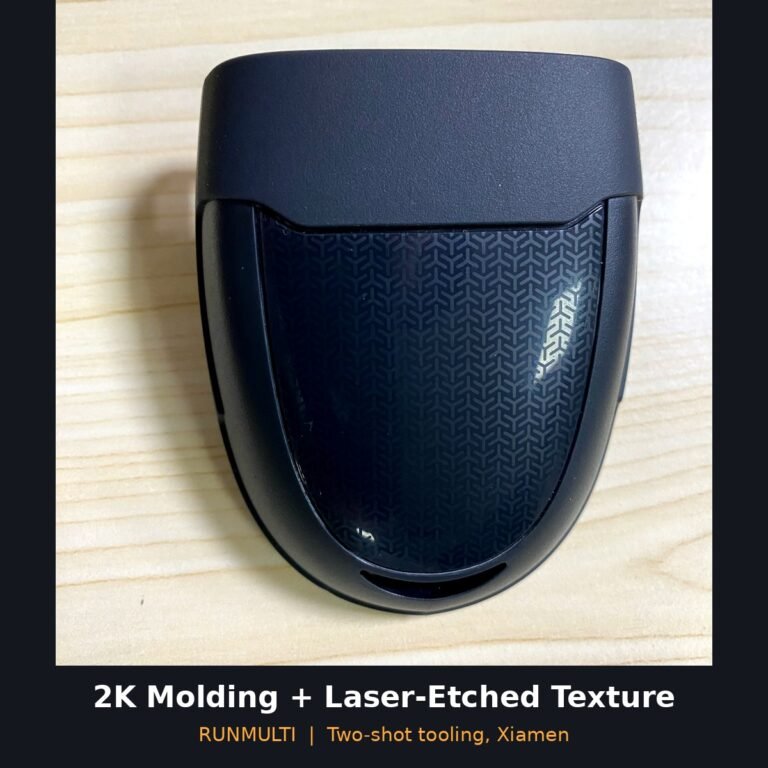
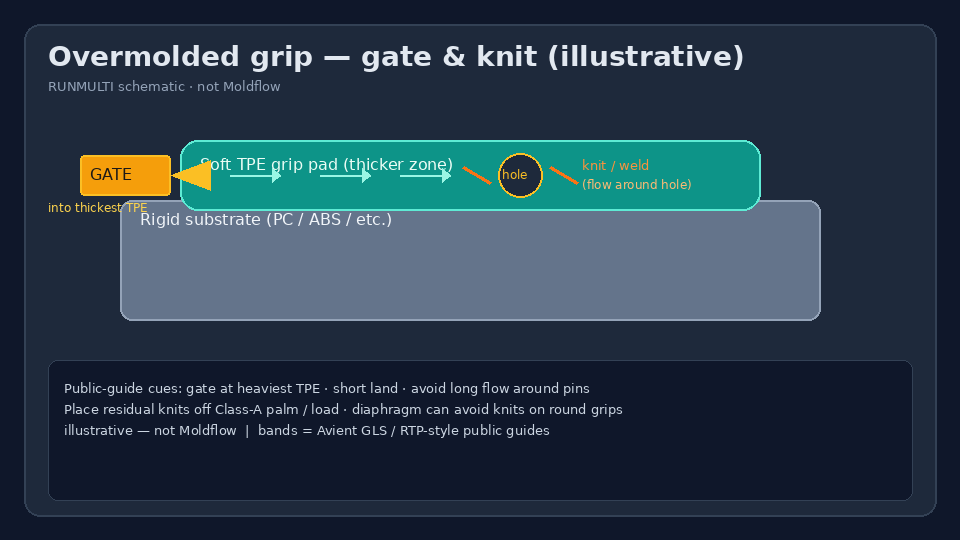
RUNMULTI illustrative featured image: gate into thick TPE; knit mark at a through-hole. Planning heuristics only — not Moldflow.
For EU and US product and sourcing engineers specifying overmolding or two-shot molds. Gate and flow bands follow public TPE design-guide language (Avient GLS / RTP-style). Process choices are shop heuristics / 【估算】 — not RUNMULTI lab or Moldflow numbers.
Why gate location matters on soft grips
On a TPE soft zone the gate controls four things at once: fill, packing (sink / voids / bond pressure), the adhesion path across the substrate face, and cosmetics (vestige + knit placement). Move the gate a few millimeters and you can put a weld on the palm or tear the soft at auto-degate. Gate debate belongs in DFM next to resin pairing (TPE–substrate compatibility) and shut-off design.
Public-guide gate placement (rewritten)
Starting bands from public Avient GLS / RTP-style guides, not guarantees:
- Gate into the thickest TPE cross-section so packing starts where the soft is heaviest.
- Keep a short gate land for a known break / stress concentration (public guides).
- Prefer a short flow path; avoid long travel around cores, pins, and logo islands when one gate can cover the zone.
- Treat ~150:1 L/T as an absolute-max flow-ratio band for many overmold apps (Avient); RTP likewise flags L/T above ~150 as a reason to add gates or thicken the soft.
- Aim melt to impinge on a cavity wall to limit jetting (public guidance).
【估算】 shop heuristic: on a long thin wrap, sketch L/T before freezing gate count. One gate into thick stock often beats two gates that create a palm-face knit.
Gate-type comparison for overmolded grips
Rewritten from public Avient GLS gate-comparison concepts:
| Gate type | Advantages (grip context) | Disadvantages / watch-outs |
|---|---|---|
| Edge / tab | Fits flat grip pads; easy to machine and tweak | Post trim; larger vestige — keep off Class-A palm |
| Submarine (tunnel) | Auto degate; small vestige | Harder to cut/extract; soft TPE elasticity makes auto-degating harder (Avient) |
| Back-gate through substrate hole | No vestige on front grip face | More complex; reverse trim; possible sink |
| Diaphragm | Round grips; concentric fill; can avoid knits (public-guide concept) | Gate/runner scrap; post-mold removal |
| Pin / 3-plate | Auto degate; small vestige | Floater plate; more scrap; higher tool cost |
| Valve / hot runner | Tight vestige; positive shut-off | Cost and maintenance; hot-runner only |
Public-guide note (Avient): softer, highly elastic TPEs fight submarine and 3-plate self-degating more than harder or filled grades. Do not assume a tunnel that worked at 90A will shear cleanly at 40A.
Knit / weld lines on grips
Knits form where melt fronts meet after splitting — around fastener through-holes, logo islands, core pins on a wrap, or multiple gates on a long soft strip. On a soft skin a knit can be cosmetic (visible on the palm) or structural (first tear under peel or twist). Public guides: minimize flow around cores/pins when possible; place residual knits off load and off Class-A faces. For round grips, a diaphragm gate is the classic public-guide way to keep fill concentric and avoid knits — at the cost of scrap and post-trim.
【估算】: a logo cutout in a palm pad usually implies a knit somewhere on the soft perimeter unless short-shot mapping proves otherwise — keep the weld off the primary grip face.
Related: designing wearable housings for overmolding.
Substrate + soft interaction
Gate so the flow path supports adhesion: melt should wet and press the bond face, not race into a feather edge first. Two patterns:
- Face gate into thick TPE over a prepared bond zone — simple, but manage vestige.
- Back-gate through a substrate hole — clean front cosmetics (Avient concept); tradeoffs are hole design, sink risk, and reverse trim.
A perfect gate will not save an incompatible resin pair — see TPE overmolding material compatibility. Soft-edge flash remains a parallel item: shut-off design in 2K molds.
RFQ / DFM checklist before steel
| Check | Good looks like |
|---|---|
| Soft job | Grip / wrap / logo island named; Class-A palm marked |
| Gate intent | Front / back / edge; auto-degate yes/no |
| Thickness map | Soft thickest where gate can sit |
| Flow ratio | L/T sketch vs ~150:1 public-guide band |
| Knit plan | Expected welds marked; off palm / off load |
| Obstructions | Holes, logos, pins called out |
| Gate type | Edge / sub / back / diaphragm / 3-plate / valve + reason |
| Vestige | Max size or “invisible on palm” |
| Substrate hole | If back-gating: size, location, sink risk |
| Resin pair | Grades locked or “propose + peel plan” |
| Process | Insert vs 2K; volume; post-T1 change risk |
| Cosmetics | Flash-free and knit-critical faces on 2D |
What to send a China mold supplier
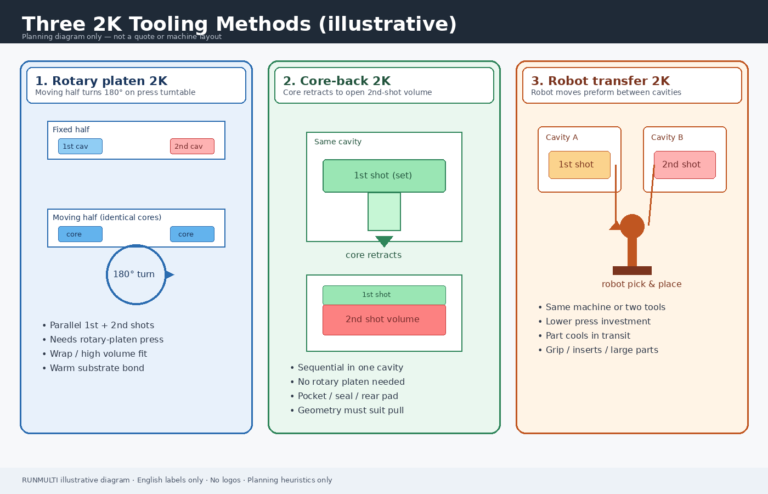
STEP + 2D, plus: soft purpose and Shore A band; substrate + soft grades or “propose + peel coupons”; preferred gate face and whether auto-degating is mandatory; Class-A palm / logo faces and vestige language; through-holes, logos, and wrap paths that split flow; insert vs 2K preference, annual volume, and post-T1 change risk; whether back-gating through the substrate is acceptable. That stops quotes that put a tab gate on the palm “because it was easiest to machine.”
How RUNMULTI reviews gate & knit risk
RUNMULTI (Xiamen RUNMULTI Co., Ltd) designs multi-material molds with soft-zone gate intent, knit placement, shut-off, and resin pairing reviewed in Creo and Siemens NX before steel, backed by 20+ years of mold engineering (including 2K / overmold). Better to argue gate face and weld location in CAD than watch soft pads tear at a logo island on the line. No fake Moldflow scores or peel lab numbers — engineering judgment against public-guide bands and your drawing.
Next step: a paid DFM review
If gate face, auto-degate, or knit placement is still open, order an Independent DFM Review before freeze. Tiers: Quick Check $195 · Standard $595 · 2K / Overmold Pro from $1,250. Pro covers bonding, shut-off, soft thickness, gate/knit risk, and tooling method. Review fee is credited toward your mold order if you order within 10 business weeks of delivery; the report is yours to take anywhere.
Or contact us with STEP, substrate + soft grades, grip cosmetics callouts, preferred gate face, volume, and whether auto-degating is required.
RUNMULTI — Xiamen, China. Custom injection molds, two-shot (2K) molding, and overmolding for EU & US brands.